NeoPixel Breakout Board Assembly Guide
Table of contents
Table of contents
Introduction
The NeoPixel Breakout Board is a key expansion in the LCC Fusion lighting and automation system, designed to drive up to eight NeoPixel LED strips (e.g., WS2812, SK6812). Each strip is connected via a 3-pin pixel header (Signal, 5 V, GND) and receives individual data signals .
The board regulates voltage from the accessory AC/DC/DCC PWR BUS using a KBL406 bridge rectifier and LM2596-ADJ step-down regulator, producing a clean, stable 5 V output. A TVS diode and a resettable PPTC fuse protect the rail and connected LEDs. Optional power may also be supplied from Line 8 on the PWM Card.
Built to match the modular design of all LCC Fusion PCBs, this board allows clean and distributed lighting control with built-in protection.
System Overview
The NeoPixel Breakout Board connects only to the Node Card’s “I/O DEVICES” RJ45 connector (J7) using a standard network cable. The Node Card provides the data lines from its local ESP32 GPIO, and L7/L8 (JP2/JP3) must be set to “I/O” for NeoPixel operation.
Each NeoPixel strip receives:
- Signal: 3.3 V data signal (1 kΩ series resistor for protection)
- Power: Regulated 5 V from onboard LM2596-ADJ
- Ground: Common GND plane with source protection
flowchart LR
subgraph layout ["Train Layout"]
  n["Node Card"]
  bb["NeoPixel Breakout<br/>Board"]
  p["NeoPixel Strips (1–8)"]
  acc["PWR BUS<br/>(12–45 V AC/DC)"]
end

can["CAN Network"] --> n

n <--> |"NeoPixel Data Signal lines"| bb
bb -.- |"NeoPixel data + 5 V power"| p
acc -.- |"Via bridge rectifier + 5 V regulator"| bb

classDef layoutStyle fill:#f5f5f5,stroke:#888,stroke-width:2px;
classDef boardStyle fill:#FFE4B5,stroke:#333,stroke-width:2px;
class bb boardStyle;
class layout layoutStyle;
Assembly Instructions
This section combines both the component specifications and the assembly instructions to ensure a smooth assembly process. Below is a comprehensive list of components, their placement on the PCB, and orientation details to assist you during assembly.
High-Level Steps for Assembly:
- PCB for the card can be ordered from any PCB fabricator using these Gerber Files.
- Clean PCB with alcohol to remove residue. See Cleaning_PCB for details.
- See also: Soldering Tips
- PCB Components - listing of components used for PCB assembly
- PCB Parts - listing of parts used for PCB assembly

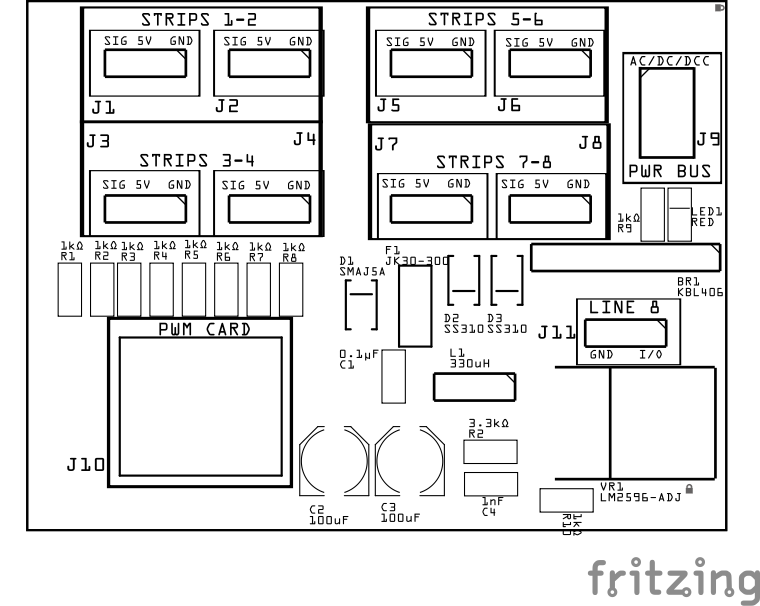
Required Components
| Reference | Count | Type | Value | Package | Purpose | Orientation |
|---|---|---|---|---|---|---|
| Bridge Rectifiers | ||||||
| BR1 | 1 | Bridge Rectifier | KBL406 | PTH | Handles up to 4 A input from AC/DC/DCC accessory bus | Position the rectifier’s clipped corner (pin 1) toward PCB right edge |
| Capacitors | ||||||
| C1 | 1 | Capacitor (Ceramic) | 0.1 µF | 1206 X7R | Regulator noise suppression | None |
| C2–C3 | 2 | Capacitors (Electrolytic) | 100 µF | 6.3x5.8mm , SMD | Input/output filtering (regulator) | Anode positioned toward PCB top edge |
| C4 | 1 | Capacitor | 1 nF | 1206 X7R | LM2596 FB noise suppression | None |
| Diodes | ||||||
| D1 | 1 | TVS Diode | SMAJ5.0A | SMA SMD | Protects 5 V output rail from spikes | Cathode end has a white line and positioned towards PCB left edge |
| Connectors / Selectors | ||||||
| J1–J8 | 8 | Connectors | 3-pin headers | PTH | Pixel strip connections (SIG / 5V / GND) | None |
| J9 | 1 | JST XH Socket or 2-Position Spring Terminal Connector | 2P, 2.54mm | PTH, vertical or horizontal | PWR input via accessory bus | None |
| J10 | 1 | RJ45 Socket | 8P8C | PTH | Network cable from PWM Card | Fits only one way |
| JP1 | 1 | Male Header | 3P, 2.54mm | n/a | Use Jumper Cap to select if Line 8 is for a common GND or for data signal (SIG) | None |
| Indicators | ||||||
| LED1 | 1 | LED | Red | 1206 SMD | Power indicator | Reference back of LED, position cathode towards PCB left edge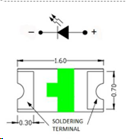 |
| Fuse | ||||||
| F1 | 1 | PTC Polymer Fuse | JK30, 3 A, 16 VDC (or more) | 5.1mm pitch, PTH | Resettable 3 A fuse for 5 V output protection | None |
| Resistors | ||||||
| R1–R8 | 8 | Resistors | 1kΩ | 1206 SMD | Series resistors for each NeoPixel signal (DIN lines) | None |
| R9 | 1 | Resistor | 1kΩ | 1206 SMD | LED current limit resistor | None |
| R10 | 1 | Resistor | 3.3kΩ | 1206 SMD | LM2596 feedback resistor | None |
| Inductors | ||||||
| L1 | 1 | Inductor | 330 µH | 8x10mm, PTH | Required for LM2596 switching circuit | None |
| Voltage Regulators | ||||||
| VR1 | 1 | Voltage Regulator | LM2596-ADJ | SMD | Step-down switching regulator | Fits only one way |
Connector Assignments
| Header | Description | Connected Components |
|---|---|---|
| J1–J8 | Pixel Strip Outputs | NeoPixel strips (SIG/5V/GND) |
| J9 | Power Input | 12–45 V AC/DC/DCC |
| J10 | PWM Card Input | 7 or 8 signal lines via CAT5/6 |
LINE 8 Selector (GND, SIG)
Lines 1–7 are always NeoPixel data outputs. Line 8 can be configured as either:
- GND (ground reference carried in the RJ45 cable)
- SIG (8th line is a data signal)
Use GND when the Node Card power supply and the layout accessory bus power supply do not share a guaranteed common ground, or when you are unsure. Use DATA 8 only when you have confirmed that Node GND and accessory-bus GND are bonded at a known point.
Note: NeoPixel data signaling requires a shared ground reference. If the RJ45 cable does not carry ground (DATA 8 mode), the Node and breakout must be grounded together elsewhere or the strips may flicker or not respond.
Appendences
PCB Specifications
| Characteristic | Value |
|---|---|
| Supported Strips | 1–8 NeoPixel |
| Output Voltage | 5 V Regulated |
| Max Output Current | 2 A (with PPTC limit) |
| Input Voltage Range | 12–45 V AC/DC |
| Strip Connector Format | 3-Pin (SIG/5V/GND) |
| Data Source | PWM Card via RJ45 |
How It Works
The NeoPixel Breakout Board distributes NeoPixel data signals and regulated 5 V power to up to eight NeoPixel-compatible LED strips (e.g., WS2812, SK6812). Each strip connects to a dedicated 3-pin output header (Signal, 5 V, GND) and is driven directly by the Node Card’s ESP32 GPIO pins via a standard network cable connected to the Node Card’s I/O DEVICES (J7) connector.
Lines 1–7 on the network cable are always used as NeoPixel data outputs. Line 8 can be configured as either an additional data output or a ground reference, depending on whether the Node Card power and the layout accessory bus share a common ground.
Power Input and Regulation
Power is supplied from the Accessory Bus (AC, DC, or DCC, typically 12–45 V) and enters the board through a KBL406 bridge rectifier, ensuring correct polarity regardless of input type.
The rectified DC feeds an LM2596-ADJ switching regulator, which steps the voltage down to a stable 5 V rail suitable for NeoPixel strips. The 5 V rail is filtered using bulk capacitors and protected by:
- A SMAJ5.0A TVS diode for transient suppression
- A JK30-300 resettable fuse (PPTC) providing over-current protection
This regulated 5 V rail is shared across all eight NeoPixel output headers.
Shared 5 V Power Rail
All eight NeoPixel outputs share the same regulated 5 V supply. Protection on the 5 V rail includes:
- TVS diode clamping to protect against cable hot-plugging and inductive transients
- Resettable fuse protection that trips under short-circuit or overload conditions and automatically resets after cooldown
This design allows multiple NeoPixel strips to be powered safely from a single breakout board while maintaining fault tolerance.
Ground Reference and Line 8 Selection
NeoPixel data signaling requires a shared ground reference between the Node Card and the NeoPixel strips.
- If the Node Card power supply and the layout accessory bus do not share a guaranteed common ground, Line 8 must be set to GND so the ground reference is carried through the network cable.
- If a solid common ground already exists elsewhere in the system, Line 8 may be used as an eighth data output.
Using Line 8 as GND is the recommended default for maximum reliability.
PCB Protection Overview
| Protected Component | Protection | Purpose |
|---|---|---|
| 5 V Rail to Strips | TVS (SMAJ5.0A) | Clamps power spikes on shared rail |
| Regulator Output | PPTC (JK30) | Cuts output current >3 A, resets when cool |
| NeoPixel DIN Lines (1–8) | 1 kΩ Resistors | Protects first pixel inputs from overvoltage and overshoot |
| Regulator Input | KBL406 Rectifier | Allows AC/DC/DCC input, blocks reverse polarity |