LCC Fusion Podcast – BOD Card & Breakout Board

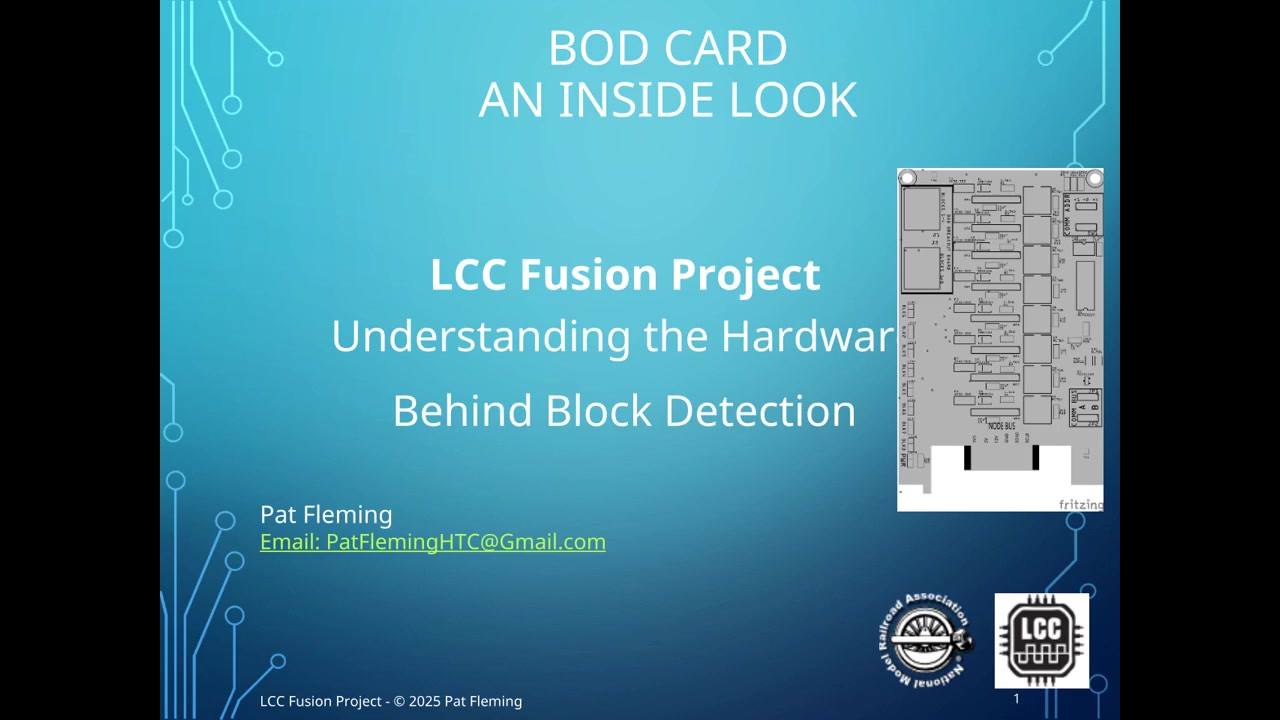
In this LCC Fusion podcast episode, Nelson and Harrison explore how train detection works using the BOD Card and the Block Breakout Board.
These two boards work together to deliver accurate, modular, and layout-friendly block detection with minimal wiring.
Watch the Podcasts
AI-Assisted Production Notice
This podcast uses AI-generated voices based on the author's guidance, notes, and technical material. The goal is to present the information clearly and consistently, and to keep it easy to update as the LCC Fusion Project evolves.
All technical content, explanations, and project decisions are human-authored.
What these episodes cover
🚦 Understanding Block Occupancy Detection
- What “block detection” means in an LCC Fusion layout
- Why Fusion uses current-sensing for reliable occupancy reporting
- How each BOD Card supports 8 detection channels
- How each Block Breakout Board connects to 4 blocks, and why a BOD Card supports two breakout boards (total of 8 blocks)
🔌 How the BOD Card Works
- Measuring block current to detect train presence
- Key components used for stable detection
- LED indicators for each block
- “No solder jumpers” design—plug in network cables and go
- How the BOD Card sends LCC Events to the CAN Bus for automations, signals, sound triggers, etc.
🧱 The Block Breakout Board
- The four input/output connectors for Mainline and Block wiring
- Using simple network cables to connect Block Breakout Boards to the BOD Card
- Why Breakout Boards reduce wiring complexity on your layout fascia or under the benchwork
- How the board helps keep detection reliable even with long runs
🧩 Integrating Detection Into an LCC Layout
- How multiple BOD Cards can be distributed around the layout
- How Fusion uses LCC Events so signals, logic, and automation respond instantly
- Pairing BOD Cards with BSD (Short Detection), BRD (Reversing Loop Detection), and BLVD cards
- Tips on locating cards for best power and cable routing
🔧 Best Practices
- Choosing where each detected block begins and ends
- Avoiding false positives by grouping feeders correctly
- Using the Hub + Node Card to minimize wiring
- Verifying block detection using the Node Card serial monitor
- Why testing each block at the Block Breakout Board saves time later
Why LCC Fusion’s Detection System Stands Out
Fusion builds on standard NMRA LCC practices with enhancements:
- Clear separation of BOD Card (electronics) and Block Breakout Board (track wiring)
- Support for two Block Breakout Boards per card
- Network-cable interconnects that eliminate messy point-to-point wiring
- Self-testing via Node Card firmware
- Automatic I²C card identification
- Consistent physical card format for easy stacking and expansion
Together, the BOD Card and Block Breakout Board form a clean, scalable, and predictable detection solution for layouts of all sizes.
Downloads and Documentation
-
Full LCC Fusion Documentation: https://patfleming.github.io/LccFusionProject/
-
GitHub Repository: https://github.com/patfleming/LccFusionProject
-
LCC Fusion Podcasts Playlist: https://www.youtube.com/playlist?list=PLg49NFDgDCLRS7j30iTitaWUlfIdiw0Wx
-
Download Block Breakout Board presentation with speaker notes (PPT)