 |
LCC Fusion Project 1.0
LCC Automation
|
|
LCC Fusion Project 1.0
LCC Automation
|
Namespaces | |
| namespace | pstTestPinsMri |
| Human‑readable messages for pin self‑tests. | |
| namespace | i2cCardIdMgrMri |
| Messages used by I2cCardIdMgr for card ID programming. | |
| namespace | serialIoMri |
| Messages used by the SerialIO console helper. | |
| namespace | soundCardMri |
| Help and status strings for the Sound Card firmware. | |
| namespace | audioCardMri |
| Help and status strings for the Audio Card firmware. | |
| namespace | bsdCardMri |
| Help and diagnostic strings for the Block Sensor (BSD) card. | |
| namespace | uodCardMri |
| Help and diagnostic strings for the Ultrasonic Object Detection (UOD) card. | |
| namespace | hwCheckIdMri |
| Status messages for hardware ID detection. | |
Classes | |
| class | CpuCheckTimer |
| A timer that periodically checks CPU load and logs a warning if it exceeds a configured threshold. More... | |
| class | I2cCardIdMgr |
| Manager for reading/writing/verifying small identity records on 24LC02 EEPROMs over I²C. More... | |
| class | OledDisplay |
| Simple text console for a 128×64 SSD1309 OLED on a dedicated I²C bus. More... | |
| class | PstTestPins |
| One-stop pin self-test utility with a single dispatcher entry point. More... | |
| class | SerialIO |
| General-purpose input handler for text-based packets over multiple transports. More... | |
Macros | |
| #define | LCD_BASE_ADDRESS 0x3C |
| Base I²C address for the 128x64 OLED display (SSD1306/SSD1309). More... | |
| #define | MCP23017_BASE_ADDRESS 0x20 |
| Base I²C address for the MCP23017 port expander. More... | |
| #define | SOUND_CARD_BASE_ADDRESS 0x30 |
| Base I²C address for the Sound Card’s DFPlayer controllers. More... | |
| #define | PCA9685_BASE_ADDRESS 0x40 |
| Base I²C address for the PCA9685 16‑channel PWM driver. More... | |
| #define | EEPROM_BASE_ADDRESS 0x50 |
| Base I²C address for on‑card 24LC01/02 EEPROM devices. More... | |
| #define | BSD_CARD_BASE_ADDRESS 0x58 |
| Reserved base address for Block Sensor (BSD) cards. | |
| #define | UOD_CARD_BASE_ADDRESS 0x68 |
| Reserved base address for Ultrasonic Object Detection (UOD) cards. | |
| #define | AUDIO_CARD_BASE_ADDRESS 0x60 |
| Reserved base address for Audio Card peripherals. | |
| #define | HASSERT(x) |
| Hardware assertion with logging. More... | |
Enumerations | |
| enum | CardType : uint8_t { CARD_NODE , CARD_QUAD_NODE , CARD_DCC , CARD_SOUND , CARD_AUDIO , CARD_UOD , CARD_BSD , CARD_COUNT , CARD_NOT_FOUND = 0xFE , CARD_NOT_IDENTIFIED = 0xFF } |
| Enumerates all card categories recognizable by the HW ID signature. More... | |
Functions | |
| static CardType | detectHwId () |
| Detect the type of LCC Fusion card attached via the HW_ID_PIN. More... | |
| static bool | verifyCardType (CardType expectedCard) |
| Verify that the detected hardware matches the expected card type. More... | |
Variables | |
| static constexpr uint8_t | NUM_REMOTE_PLAYERS_PER_CARD = 4 |
| number of players to be configured on each of the remote sound cards (devices) | |
| const CardSignature | cardSignatures [CardType::CARD_COUNT] |
| Lookup table of expected HW_ID voltage ranges for each card type. More... | |
| static constexpr size_t | CMD_BUF_SIZE = 64 |
| Maximum buffer size for one command (excluding null) | |
The LccFusionCore library is the shared firmware foundation for the LCC Fusion Project. It provides common classes, helpers, and utilities used by all ESP32-based cards (Node Card, BSD, UOD, Audio, Output, Sensor, DIO, etc.), so that each card sketch can remain small and focused.
Instead of duplicating logic in every firmware sketch, LccFusionCore centralizes:
Any LCC Fusion card firmware that includes LccFusionCore.h can leverage these building blocks with minimal glue code.
The library is organized into a set of headers that each provide a specific area of functionality, including (but not limited to):
The goal is to make card sketches mostly about configuration and wiring, with common behavior implemented once in LccFusionCore.
Some of the key headers exposed by the library include:
LccFusionCore.hHwIdCheck.h (or equivalent)LccNodeMri.hLccNode.h and related node helpersSerialIoHelper.h (or similar)Refer to the generated Modules and Classes sections for complete lists of types and functions.
To use LccFusionCore in an Arduino-based ESP32 sketch:
Arduino/libraries/ folder (or via the board package that bundles it).In your sketch, include the main header:
LccNode (or equivalent) instance from the core library.setup() to configure the node, card ID, I²C, and any detection hardware.loop(), call the core library's update / poll functions so that events, timers, and diagnostics can run.Individual cards (BSD, UOD, Audio, etc.) typically provide thin sketches that follow this pattern and then add card-specific configuration.
A very simplified sketch using LccFusionCore might look like:
In real card firmware, the core library provides concrete types and functions for node setup, CDI handling, event producers/consumers, and self-test harnesses.
LccFusionCore is intended to be used alongside one or more card firmware sketches in the LCC Fusion Project. The typical relationship is:
For more details on specific cards, see the card-level firmware pages (BSD Card, UOD Card, Audio Card, Node Card, etc.) in the generated documentation.
These resources provide assembly guides, wiring documentation, CDI configuration tools, and higher-level usage tutorials that complement this API reference.
| #define EEPROM_BASE_ADDRESS 0x50 |
Base I²C address for on‑card 24LC01/02 EEPROM devices.
Every card (except the Node Card) includes a tiny serial EEPROM that stores its identity record. The address of each EEPROM is EEPROM_BASE_ADDRESS + offset, where offset derives from the card’s address switch (0–7). See I2cCardIdMgr for reading and writing these records.
Definition at line 88 of file CardVars.h.
| #define HASSERT | ( | x | ) |
Hardware assertion with logging.
Evaluates the expression x and, if it is false, prints a detailed diagnostic message to the Serial console, including the file name, line number and the failed expression string. It then triggers a standard assert(0) followed by abort() to halt execution. Use this macro in code paths that must never be reached or to enforce hardware assumptions during development. When the expression evaluates to true the macro expands to a no‑op.
| x | Boolean expression to test. |
Definition at line 58 of file LccMacros.h.
| #define LCD_BASE_ADDRESS 0x3C |
Base I²C address for the 128x64 OLED display (SSD1306/SSD1309).
All displays used in the LCC Fusion project expose their controller at 7‑bit address 0x3C. Adjust this constant if your hardware uses a different address (for example, 0x3D).
Definition at line 45 of file CardVars.h.
| #define MCP23017_BASE_ADDRESS 0x20 |
Base I²C address for the MCP23017 port expander.
Each card that uses the 16‑bit I/O expander (MCP23017) ties the A2:A0 address lines to the 3‑bit address switch on the PCB. The effective address is computed as MCP23017_BASE_ADDRESS + offset, where offset comes from the switch setting. This constant is defined here to allow overriding the default (0x20) if needed.
Definition at line 57 of file CardVars.h.
| #define PCA9685_BASE_ADDRESS 0x40 |
Base I²C address for the PCA9685 16‑channel PWM driver.
Cards that drive servos or LED dimmers use the PCA9685. Similar to MCP23017, its address lines map to the card’s address switch.
Definition at line 76 of file CardVars.h.
| #define SOUND_CARD_BASE_ADDRESS 0x30 |
Base I²C address for the Sound Card’s DFPlayer controllers.
DFPlayer modules do not expose I²C; however, the Sound Card uses this address range for its on‑board configuration EEPROM. See also I2cCardIdMgr for details on card programming.
Definition at line 67 of file CardVars.h.
| enum CardType : uint8_t |
Enumerates all card categories recognizable by the HW ID signature.
Each enumerator corresponds to a distinct LCC Fusion card. The detection logic in detectHwId() measures the analog voltage on HW_ID_PIN and selects one of these values based on the configured voltage ranges. The final two sentinel values are used to report absence of a card or failure to match any known signature.
| Enumerator | |
|---|---|
| CARD_NODE | Node Card: generic I/O lines and NeoPixel support |
| CARD_QUAD_NODE | Quad‑Node Card: four Node Cards on one PCB |
| CARD_DCC | DCC Card: drives DCC signals for model railroads |
| CARD_SOUND | Sound Card: DFPlayer‑based sound playback |
| CARD_AUDIO | Audio Card: ESP32‑native I²S and TTS playback |
| CARD_UOD | Ultrasonic Object Detection (UOD) card |
| CARD_BSD | Block Sensor (BSD) card measuring current draw |
| CARD_COUNT | Number of recognized cards in the lookup table |
| CARD_NOT_FOUND | Sentinel meaning no card present on the HW_ID_PIN |
| CARD_NOT_IDENTIFIED | Sentinel meaning the measured voltage did not match any signature |
Definition at line 97 of file HwIdCheck.h.
|
inlinestatic |
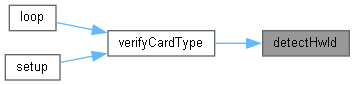
Detect the type of LCC Fusion card attached via the HW_ID_PIN.
Reads the analog voltage on HW_ID_PIN and compares it against the voltage ranges defined in cardSignatures. If the voltage falls below roughly 0.3 V the function concludes that no card is connected (returns CARD_NOT_FOUND). If the voltage lies within one of the predefined ranges it prints the detected card name and returns the corresponding CardType. Otherwise it prints that the card is unknown and returns CARD_NOT_IDENTIFIED.
Definition at line 172 of file HwIdCheck.h.
|
inlinestatic |
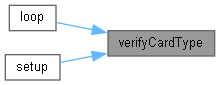
Verify that the detected hardware matches the expected card type.
Invokes detectHwId() and compares the result with expectedCard. If the function detects CARD_NOT_FOUND (no card inserted) it returns true to allow firmware to be programmed into a bare ESP32. For any other mismatch it prints an error message and returns false.
| expectedCard | The card type required by the running firmware. |
| true | The detected card matches expectedCard or no card is present. |
| false | The detected card type does not match and a mismatch was reported. |
Definition at line 209 of file HwIdCheck.h.

| cardSignatures |
Lookup table of expected HW_ID voltage ranges for each card type.
Each entry corresponds to a value in CardType (from CARD_NODE up to CARD_BSD). The minV and maxV fields define the acceptable ADC voltage range on HW_ID_PIN for that card. detectHwId() scans this table to decide which card is currently plugged into the ESP32.
The ranges include tolerance for component variation and ADC noise, so they should only be tightened with care and after measurement on real hardware.
Definition at line 147 of file HwIdCheck.h.
 1.9.5
1.9.5